
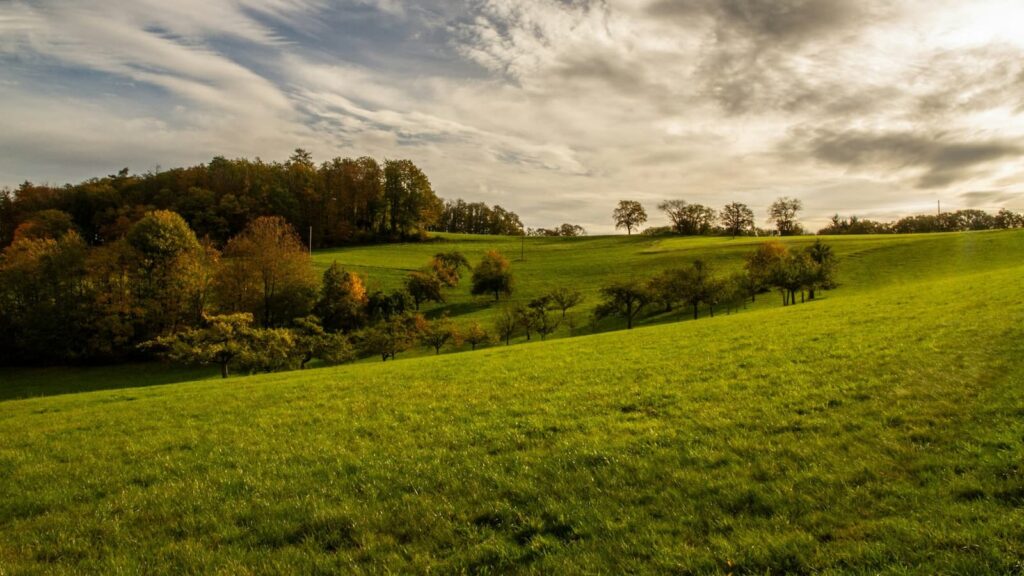
100% pasture-fed beef starts with a simple idea: cattle should be allowed to eat the kind of diet they evolved to thrive on.
They are ruminants, extraordinarily well adapted to turn grasses, herbs, leaves and other vegetation that humans cannot digest into nutrient-dense food.
At One Dexter, that is exactly what I want them to do.
The aim is simple: cattle raised entirely on pasture and forage throughout their lives, without relying on grain-based concentrate feeds to push them towards finishing more quickly.
But for me, 100% pasture-fed means considerably more than simply replacing grain with grass.
The kind of pasture matters too.
A cow grazing a monoculture of perennial ryegrass is technically eating pasture. But that is a very different nutritional and ecological environment from a landscape containing grasses, clovers, herbs, wildflowers, hedgerows, shrubs and trees.
That difference can influence the cattle themselves, the wildlife around them, the functioning of the land and even the nutritional composition of the beef they eventually produce.
Grass-fed doesn’t necessarily mean 100% pasture-fed beef
“Grass-fed” sounds reassuring. Most people would reasonably imagine cattle spending their lives outside eating grass.
Unfortunately, the term does not necessarily tell you the whole story.
An animal described as grass-fed may still receive grain or concentrate feed during part of its life, including during the finishing period before slaughter.
That is why I prefer the much clearer principle of 100% pasture-fed beef.
That does not mean cattle must eat fresh grass every day of the year. Conserved forage such as hay or haylage can form part of the diet in 100% pasture-fed beef production. At One Dexter, however, I aim to minimise even the use of conserved forage by managing the land carefully enough to allow as much deferred grazing as possible through winter. This keeps the system lower-input still, reducing the need for machinery, fuel, harvesting, storage and bought-in forage.
The important distinction is that the animal’s diet remains based entirely on pasture and forage rather than cereals or manufactured concentrate feeds.
Let cattle be cattle
A cow has one of the most remarkable digestive systems in the animal kingdom.
Its rumen contains an enormous community of microorganisms capable of breaking down fibrous plant material that humans cannot utilise directly.
That allows cattle to harvest nutrition from grasses, herbs, leaves and other vegetation and convert it into highly nutritious food.
For me, there is something fundamentally logical about building a cattle system around that ability rather than routinely feeding cattle cereal crops in order to accelerate growth.
It also fits the way I want One Dexter cattle to live.
Given appropriate land and grazing management, cattle can spend their whole lives outdoors, walking, grazing, browsing, ruminating, resting and choosing between different plants.
Rather than asking the animal to fit an intensive production system, the intention is to build the system around the animal. The result is 100% pasture-fed beef.
Pasture is more than grass
When I talk about pasture, I am not necessarily picturing a perfectly uniform field of short perennial ryegrass.
Productive ryegrass has its place in agriculture, but a monoculture provides relatively little botanical or structural diversity.
The landscapes that interest me are more complicated.
Different grasses, clovers, herbs, wildflowers, rushes, hedgerows, scrub, woodland edges and patches of taller vegetation can all form part of a landscape used by grazing cattle.
That diversity matters.
Different plants root at different depths, flower at different times and provide different resources for insects and other wildlife. Varied vegetation also creates differences in height, density, shade, shelter and microclimate.
Below ground, diverse plant communities can support equally complex relationships between roots, fungi, bacteria and other soil organisms.
And then there are the cattle themselves.
Cattle as part of the landscape
Large grazing animals have helped shape European landscapes for thousands of years.
As cattle move through an area they do far more than simply remove vegetation.
They graze some plants and leave others. They browse. They trample vegetation. They create patches of short and tall sward. They deposit dung and urine. They transport seeds. Their hooves create small areas of disturbance and exposed soil.
The result is heterogeneity: variation across the landscape.
And variation is often exactly what wildlife needs.
One insect may require short, warm turf. Another may depend on tall flowering vegetation. Birds may forage across recently grazed ground while requiring denser vegetation nearby for cover or nesting.
Dung itself supports an extraordinary community of insects and other organisms, which in turn provide food for birds, bats and other wildlife.
This is one reason cattle are increasingly used in conservation grazing, habitat restoration and rewilding projects.
Of course, grazing is not automatically beneficial simply because cattle are present.
Stocking density, timing, duration, season, soil conditions and the sensitivity of the habitat all matter. Too much grazing can simplify a landscape just as surely as too little can allow it to become dominated by a small number of competitive species.
But managed thoughtfully, cattle can become ecological participants rather than simply units of agricultural production.
Producing food without growing grain for cattle
There is another environmental distinction between a genuinely pasture-based system and one that depends heavily on concentrate feed.
Concentrate does not appear from nowhere.
Cereal and protein crops must be grown, harvested, processed and transported. Depending on the ingredients and farming system, that can involve cultivated land, fertiliser, machinery, pesticides and imported feedstuffs.
Pasture-fed cattle take a different route.
They can utilise vegetation growing on land that may be poorly suited to producing crops for direct human consumption and turn that fibrous material into food.
Permanent and species-rich grasslands can also perform functions beyond food production: protecting soils, slowing and storing water, cycling nutrients, storing carbon below ground and providing habitat for wildlife.
What interests me is the possibility of producing beef from landscapes that are also being managed for soil health, ecological complexity and biodiversity, rather than treating food production and nature as two completely separate objectives.
The value of choice
There is another reason I value diverse pasture: it gives the animal choices.
A cow grazing a ryegrass monoculture may have plenty to eat, but every mouthful is relatively similar.
Put that same animal into a more diverse landscape containing different grasses, legumes, herbs, hedgerows and browse, and the situation changes.
Different plants contain different proportions of protein, fibre, minerals and energy, but they also contain very different mixtures of naturally occurring secondary compounds, including tannins, terpenes, phenolics and flavonoids.
And grazing animals do not necessarily consume those plants at random.
Research into animal feeding behaviour suggests that ruminants can learn to associate particular foods with the effects they experience after eating them and subsequently alter their dietary choices.
This is sometimes described as nutritional wisdom or, more loosely, self-medication.
It does not mean that a cow consciously diagnoses an illness and then searches for the botanical equivalent of a medicine cabinet.
It is subtler than that.
An animal can learn from the consequences of what it eats and regulate its intake accordingly. When a variety of foods is available, it therefore has opportunities to make biologically meaningful dietary choices that simply do not exist within a monotonous pasture.
Plants can do more than provide calories
Some of those dietary choices are particularly interesting from an animal-health perspective.
Bird’s-foot trefoil, for example, contains condensed tannins.
Tannin-containing forage plants have been widely investigated for their potential to help suppress gastrointestinal parasites in grazing ruminants.
Other herbs and woody plants contain different mixtures of secondary compounds with their own biological effects.
This does not mean that every medicinal-looking plant is beneficial, or that natural compounds are automatically harmless.
They are biologically active substances, and dose matters.
Some tannins, for example, can have useful effects at moderate intakes but become detrimental at excessive concentrations.
That is another reason dietary diversity itself is so interesting. Rather than forcing every animal to consume exactly the same ration, a varied landscape can allow cattle to browse, graze and select between foods.
For me, that element of choice is an important part of allowing cattle to behave like cattle.
From pasture to beef
There is another consequence of all this botanical diversity that I find particularly fascinating.
Plants contain thousands of compounds often collectively described as phytochemicals.
These include phenolic compounds, carotenoids, terpenoids and many other plant secondary compounds.
Many phytochemicals are biologically active compounds associated with antioxidant and other potentially beneficial effects in the body. They are one reason colourful fruits, vegetables, herbs and other plants are often valued nutritionally.
We tend to think of phytochemicals as belonging exclusively to plant foods.
But that isn’t quite how a grazing ecosystem works.
When cattle eat plants, some of these compounds, or metabolites produced as the animal and its rumen microbes process them, can ultimately be detected in the animal’s tissues.
In other words, there can be a biochemical pathway from soil, to plant, to grazing animal, to beef.
Modern metabolomics research is beginning to reveal just how complicated that pathway may be.
Studies comparing pasture-finished and grain-finished beef have found substantially greater concentrations and diversity of a range of phytochemicals and their metabolites in beef from grazing animals.
That does not mean every phytochemical is automatically beneficial, or that higher levels in beef guarantee a particular health outcome. But it does mean pasture-fed beef can carry a wider range of plant-derived compounds that are of genuine nutritional interest.
One recent study found approximately 2.6 times more total phytochemicals in pasture-finished beef than in the grain-finished beef with which it was compared.
Another study tracing compounds through forage and into beef found around three times as many phytochemical antioxidants in grass-finished beef.
Among the compounds identified were metabolites linked to polyphenols in the plants the animals had eaten.
That is remarkable to me.
Why diverse pasture may matter nutritionally
This raises an important point.
Two animals can both be described as “grass-fed” while experiencing profoundly different diets.
One might graze an intensively managed field dominated by a single grass species.
Another might spend its life moving through pastures containing numerous grasses, legumes, herbs, wildflowers and browse.
Those are not chemically identical environments.
A diverse plant community exposes a grazing animal to a much wider spectrum of plant compounds than a simple monoculture.
And research increasingly suggests that some of that phytochemical diversity can ultimately be reflected in the animal products we eat.
For One Dexter, that gives me another reason to care not simply about whether cattle are fed forage, but about the quality and diversity of the landscapes providing it.
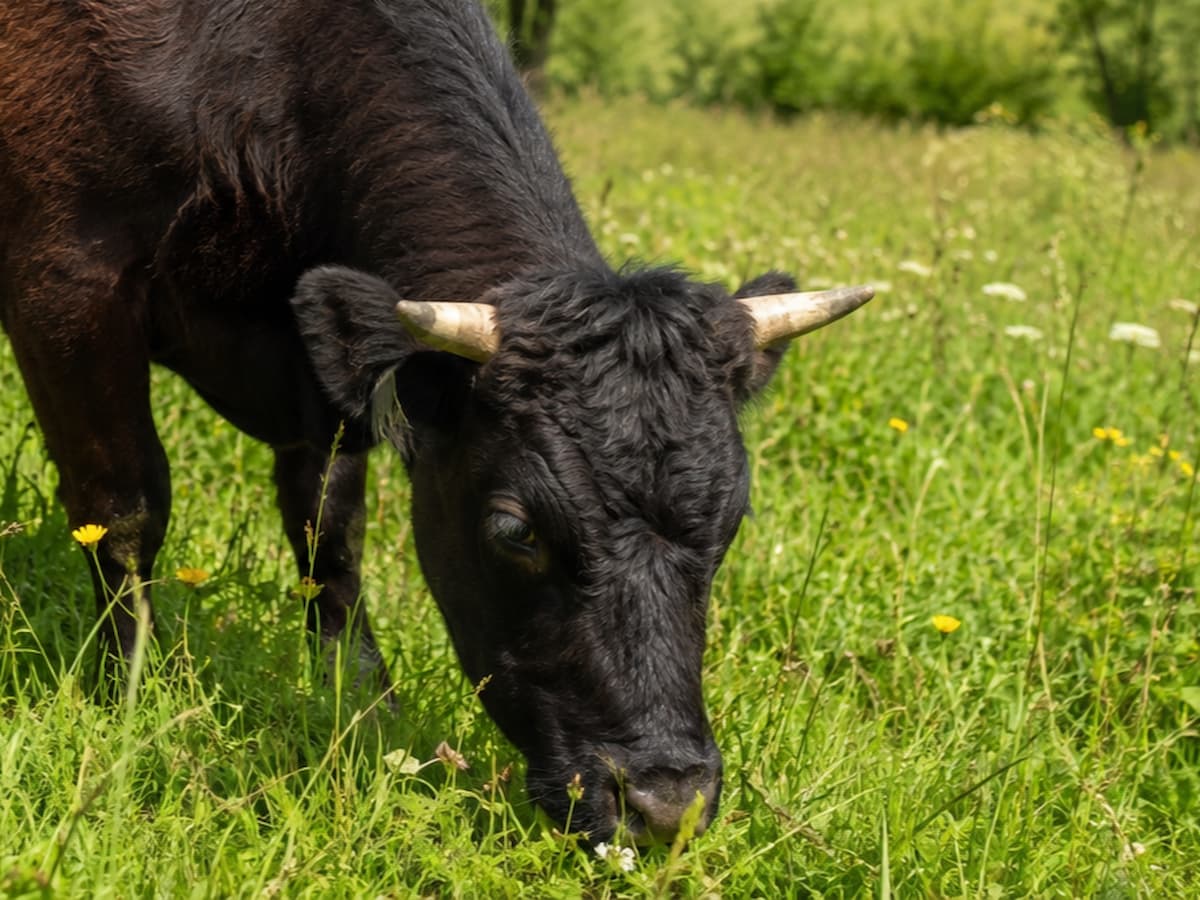
More than omega-3
The better-known nutritional differences between pasture-finished and grain-finished beef are still important.
Pasture-finished beef generally contains more omega-3 fatty acids and tends to have a lower omega-6 to omega-3 ratio.
Differences have also been reported in compounds including conjugated linoleic acid, carotenoids and vitamin E.
But the emerging research into phytochemicals suggests that the nutritional story may be considerably more complicated than fatty acids alone.
Beef is already an extremely nutrient-dense food, providing complete protein alongside highly bioavailable iron, zinc, vitamin B12 and numerous other essential nutrients.
Pasture may add another layer to that nutritional complexity.
It is important not to overstate what we currently know.
Finding higher concentrations of particular phytochemicals in pasture-fed beef does not automatically prove that eating that beef produces a specific health outcome in humans. That is a separate question requiring further research.
But we can say something simpler and, to me, equally interesting:
what an animal eats changes the composition of the food it ultimately becomes.
Why Dexter cattle fit
This is another reason I keep coming back to Dexters.
Dexters developed in the challenging landscapes of south-west Ireland and are a small, hardy native breed capable of thriving on forage-based systems.
Their relatively modest size and hardiness make them particularly interesting for the kind of varied grazing landscapes I want to work with.
They do not need to be pushed towards maximum growth in minimum time.
That fits the One Dexter approach.
I am interested in allowing cattle the time to mature on pasture rather than chasing the fastest possible finishing age.
The objective is not maximum output from an animal in the shortest possible period.
It is to produce exceptional beef from cattle raised in a way that makes sense biologically, ecologically and nutritionally.
Knowing what your animal ate
This all comes back to one of the central ideas behind One Dexter.
I don’t think provenance should stop at knowing the name of the farm your beef came from.
If you reserve a particular Dexter, I want you to be able to know far more than that.
You should be able to know the animal itself.
Where it grazed.
What kind of landscape it lived in.
What it ate.
How it was managed.
How that land changed through the seasons.
And why those management decisions were made.
Because those details matter.
A green field is not just a green field.
Pasture can be a crop, or it can be a living community of grasses, herbs, flowers, insects, fungi, soil organisms, grazing animals and countless ecological relationships between them.
That is the kind of system I want One Dexter cattle to be part of.
Not simply cattle that eat grass.
But cattle living within diverse landscapes, given the opportunity to graze, browse and choose from the plants around them, while contributing to the ecology of the land in return.
And ultimately, producing beef that carries a nutritional record of that life.
One animal. One known life. Pasture from beginning to end.
That is the kind of beef I want One Dexter to produce.