
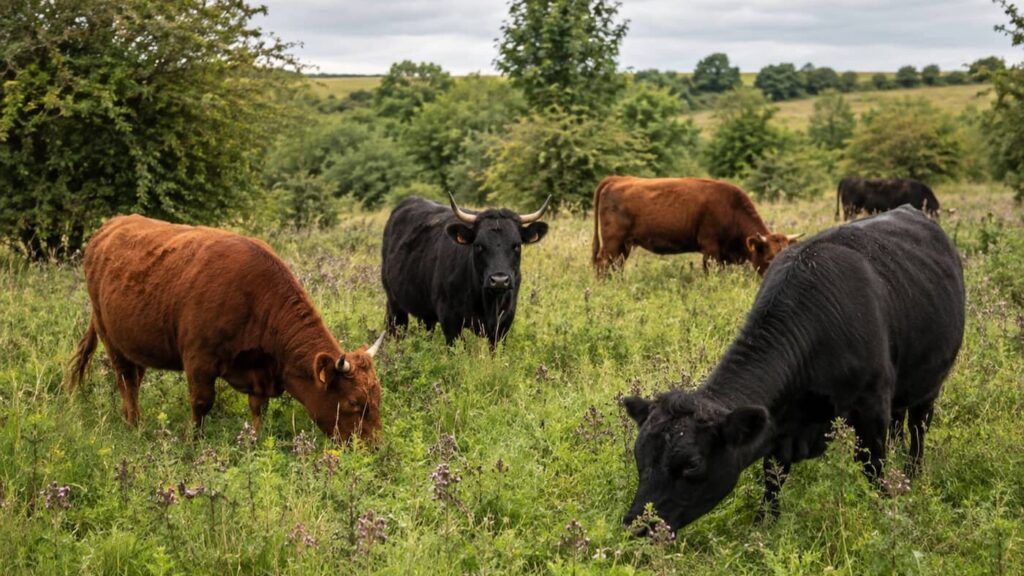
Why Dexter cattle?
Choosing the breed at the heart of One Dexter was never simply about finding cattle that produce good beef. The breed also needed to suit the way I want to manage the land, the way I want the cattle to live, and the way I want customers to connect with their food.
Dexters fit that approach remarkably well.
They are small, hardy native cattle with strong links to pasture-based farming. They are also well suited to conservation grazing and capable of producing excellent beef from forage.
Just as importantly, their smaller size makes the idea of buying the beef from one entire animal considerably more practical.
Dexter cattle have deep Irish roots
The Dexter originated in Ireland and developed from the hardy cattle associated with the country’s mountainous south-west. The breed was already being described by name in the nineteenth century and was introduced into England in 1882.
Today, the Dexter Cattle Society describes it as the smallest native breed of cattle in the British Isles.
Despite their small stature, Dexters are not miniature cattle bred simply for appearance. They are a genuine traditional dual-purpose breed, historically valued for both milk and beef.
They are also recognised by Defra as an at-risk native cattle breed under the UK’s Native Breeds Support list.
For me, that matters. One Dexter is not only about producing beef. Maintaining a viable population of a traditional native breed has value in its own right.
Dexter cattle are well suited to pasture
One Dexter is being built around a simple feeding principle: cattle should be raised and finished on pasture and forage, without grain or cereal-based concentrates.
That immediately influences breed choice.
Dexters have a reputation for hardiness, adaptability and efficient use of forage. The Rare Breeds Survival Trust describes them as capable grazers and browsers that can maintain themselves on relatively low-quality forage. The Dexter Cattle Society likewise describes the breed as compact, thrifty and hardy.
That does not mean they can simply be put onto poor land and forgotten about. Good grazing management, nutrition and animal condition still matter.
However, it does mean the breed is naturally compatible with the kind of forage-led system I want to create.
My aim is not to push cattle towards the fastest possible growth using high-energy feed. Instead, I want them to mature naturally on grasses, herbs, wildflowers, browse, hay and haylage.
Dexters give me a strong foundation for doing that.
A good fit for nature-friendly grazing
The way cattle interact with land matters just as much as what they eventually produce.
Dexters are particularly interesting in this respect.
Their relatively small body size means less weight is concentrated through each hoof than with many larger commercial cattle. That can help reduce the risk of poaching and physical damage, particularly on more sensitive ground.
They are also willing to browse as well as graze. The Rare Breeds Survival Trust specifically highlights their usefulness for conservation grazing and their willingness to browse shrubs alongside grasses.
That behaviour can be useful where the objective is more than simply producing a uniform short grass sward.
At One Dexter, I want grazing to form part of broader nature-friendly land management. That means paying attention to sward structure, recovery periods, soil condition, scrub, trees, wildlife and seasonal changes across the land.
The cattle are part of that system rather than separate from it.
Dexter beef has its own reputation
Of course, a cattle breed chosen for a beef business ultimately has to produce excellent beef.
Dexters have a long-standing reputation for doing exactly that.
On a personal level, Dexter is also my favourite-tasting beef. Taste is obviously subjective, but after eating beef from a range of breeds and production systems over the years, Dexter has consistently stood out to me for flavour.
The Dexter Cattle Society describes Dexter beef as having excellent flavour and good marbling. It also highlights the breed’s relatively small joints and good meat-to-bone ratio.
That smaller carcass is particularly relevant to One Dexter.
I am deliberately moving away from the conventional model where beef from many animals becomes largely anonymous by the time it reaches the customer.
Instead, both beef options offered by One Dexter revolve around one entire identified animal.
A Dexter produces a meaningful quantity of beef for a household without reaching the enormous carcass weights associated with some modern commercial beef breeds. That makes whole-animal purchasing much more realistic.
Smaller cattle suit the One Dexter model
The smaller mature size of Dexter cattle brings several practical advantages.
The Rare Breeds Survival Trust notes that a Dexter cow is around 360 kg, substantially lighter than many larger beef cows. That means each animal has a lower absolute forage requirement and can be accommodated more easily on relatively modest areas of land.
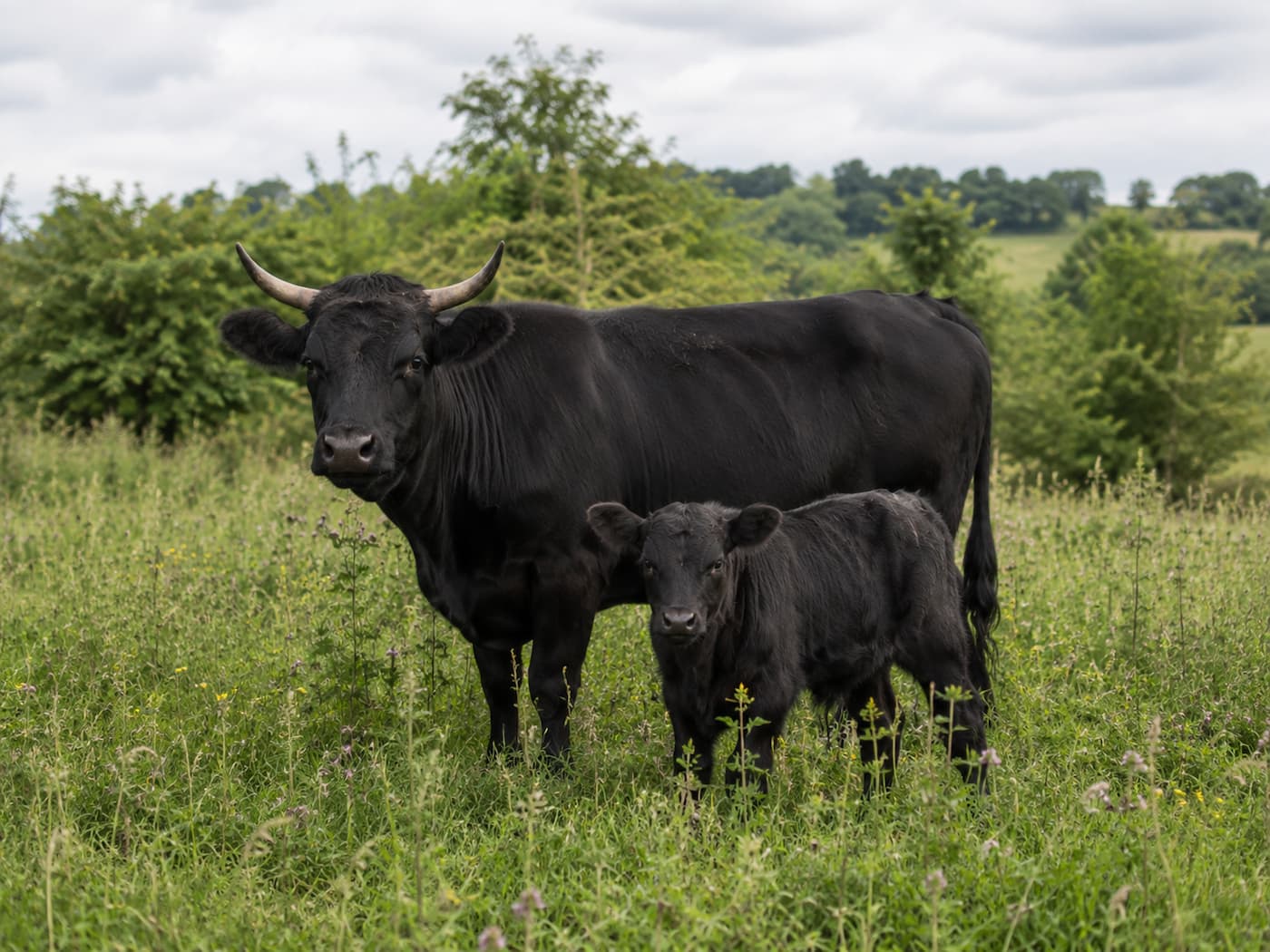
Their smaller size can also make routine handling, transport and livestock infrastructure more manageable. That does not remove the need for proper facilities or good stockmanship, but handling a compact Dexter is a different proposition from working with a much larger mature beef animal.
Their smaller carcass size is equally important. One Dexter is built around selling the beef from one entire identifiable animal rather than dividing that animal between several unrelated customers.
A Dexter can provide a substantial quantity of beef while still making a whole-animal purchase considerably more practical for a household than the much larger carcass associated with many commercial beef breeds.
For a business centred on whole-animal provenance, that smaller scale is a genuine practical advantage.
Why not use a larger commercial beef breed?
There are many excellent beef breeds in Britain. One Dexter is not based on the idea that Dexter cattle are universally better.
They are simply particularly well matched to what I’m trying to achieve.
If the objective were maximum carcass weight in the shortest possible time, I might choose very differently.
That is not my objective.
I want cattle that can work within a pasture-and-forage system. I want a breed suited to careful grazing management. I want excellent beef. I want customers to be able to buy from one entire animal. And I want to preserve the connection between the animal, the land and the food it eventually provides.
Seen through that lens, the Dexter makes a great deal of sense.
Pedigree and provenance
One Dexter also intends to work with pedigree Dexter cattle.
Pedigree registration gives another layer to the provenance I want to provide. Rather than knowing only that the beef came from “a Dexter”, I can build a record around an identifiable individual animal.
The Dexter Cattle Society maintains the breed’s herd book and pedigree records, continuing a formal recording history that stretches back well over a century.
Over time, I also intend to participate in the Society’s Dexter Beef Certification Mark Scheme and pursue Pasture for Life certification for the pasture-and-forage production system at the heart of One Dexter.
The aim is to combine independent standards with unusually detailed individual-animal provenance.
So, why Dexter cattle?
Because they bring together the things that matter most to One Dexter.
They are a hardy native breed with a long history. They are well suited to pasture and forage. Their grazing characteristics lend themselves to nature-friendly land management. They produce highly regarded beef. And their smaller size makes buying beef from one entire identifiable animal far more practical.
Most importantly, they suit the type of farming I want One Dexter to represent.
Not maximum output from anonymous cattle.
A small number of known animals, carefully managed on the land, with nothing important hidden from the people who eventually eat the beef.
One animal. Complete provenance.